

A Simple Band Budget Every Gigging Band Should Keep
Learn how to create a simple band budget, track income and expenses, and calculate whether each gig actually made or lost money.
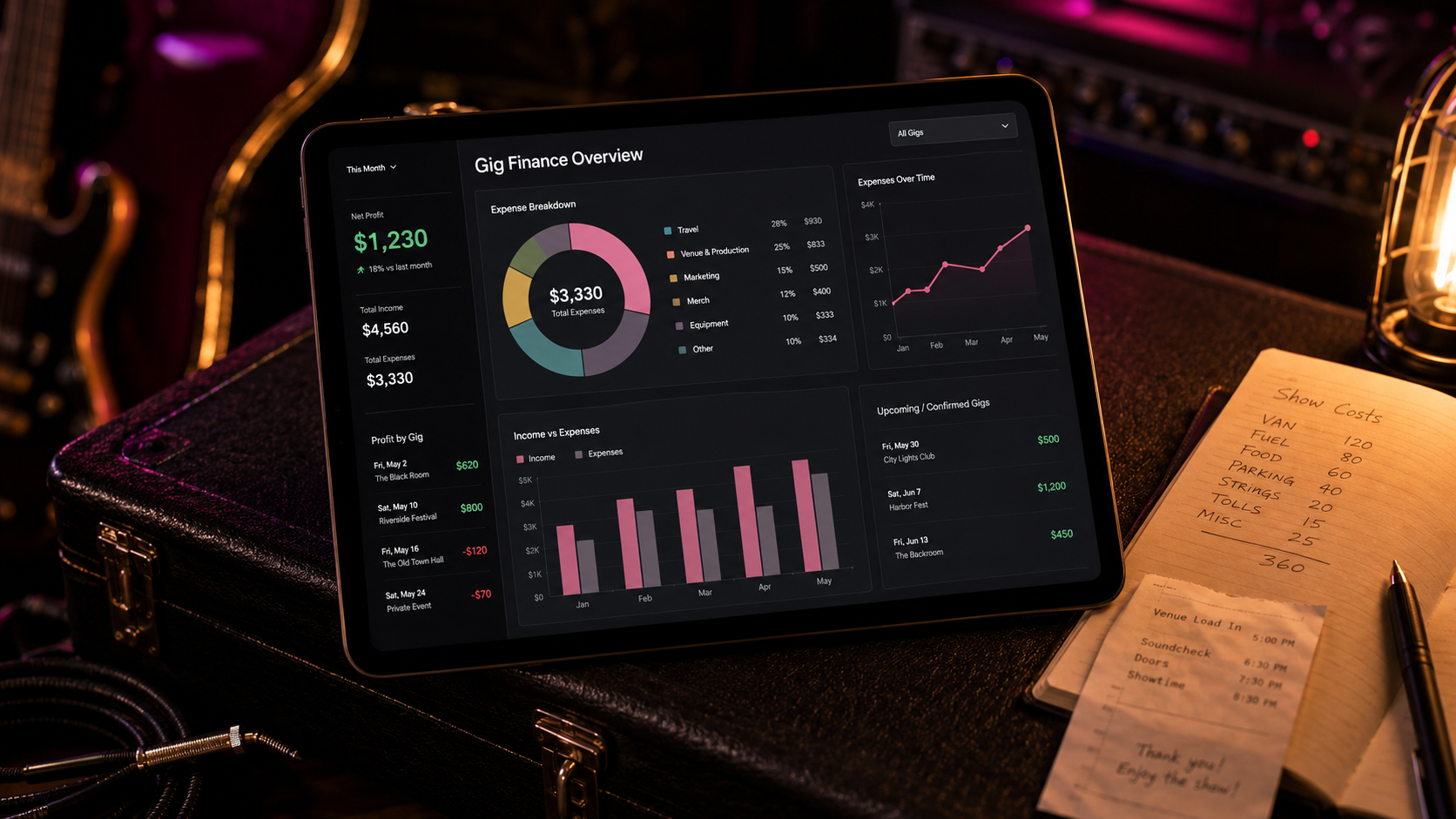
A band can play regular shows, sell merchandise, and still have no clear idea where the money is going.
That usually happens because income is remembered, but smaller expenses are forgotten. Fuel, parking, food, payment fees, rehearsal costs, and merchandise production can quickly reduce what looked like a profitable month.
A simple band budget helps you understand what the band earns, what it spends, and which shows are worth repeating.
This guide explains how to budget as a musician, which categories to track, how to calculate profit for each gig, and when a normal spreadsheet may no longer be enough.
Why Your Band Needs a Budget
A band budget gives every member a clear view of the group's finances.
It helps you answer questions such as:
- Did the last gig actually make money?
- How much are we spending on travel?
- Is our merchandise profitable?
- Can we afford to record a new release?
- Which cities and venues are worth returning to?
- How much money should stay in the band fund?
Without clear records, financial decisions are often based on guesses.
Your band may receive a €300 guarantee and think the show was successful. However, after fuel, tolls, accommodation, food, and merchandise costs, the final result may be much smaller.
Start With Income and Expenses
Every band budget has two main sides:
- Income: Money received by the band
- Expenses: Money spent by the band
Your profit is what remains after expenses are removed from income.
Total income − total expenses = profit or loss
If the result is positive, the band made a profit. If it is negative, the band lost money.
Band Income Categories to Track
Record every payment the band receives and place it in a clear category.
Performance Fees
This includes fixed guarantees and other direct payments for playing shows.
Ticket Income
Record money received from door splits, advance ticket sales, or ticket bonuses.
Merchandise Sales
Track sales from:
- T-shirts
- Hoodies
- Vinyl
- CDs and tapes
- Patches
- Stickers
- Posters
- Other products
Recorded Music
This can include:
- Streaming royalties
- Digital downloads
- Physical music sales
- Publishing payments
Other Income
Use another category for income such as:
- Crowdfunding
- Fan memberships
- Licensing
- Sponsorship
- Grants
- Donations
For a wider guide to band income, read How to Make Money From Your Band Without a Label.
The Band Expense Categories That Matter
Good band expense tracking depends on using categories that are simple enough to understand but detailed enough to be useful.
1. Travel
Travel is often one of the largest costs for a gigging band.
Track:
- Fuel
- Tolls
- Parking
- Van rental
- Train or flight tickets
- Public transport
- Vehicle repairs related to touring
Connect travel costs to the relevant show whenever possible. This helps you understand whether a distant gig was financially worthwhile.
2. Accommodation
Record spending on:
- Hotels
- Hostels
- Short-term accommodation
- Camping
- Accommodation service fees
If accommodation is provided by the promoter, record that in the show notes. It is part of the value of the deal, even when the band does not receive cash.
3. Food
Food expenses may include:
- Meals during travel
- Water
- Daily food allowances
- Catering for rehearsals or recording sessions
Agree in advance which food expenses the band covers. Personal drinks and optional purchases should not automatically become band costs.
4. Gear and Equipment
Track equipment purchases and repairs such as:
- Strings
- Drumsticks and drumheads
- Cables
- Microphones
- Pedals
- Cases
- Repairs
- Equipment rental
For expensive gear, record whether the item belongs to the band or to an individual member.
5. Promotion and Marketing
This category may include:
- Social media advertising
- Posters and flyers
- Photography
- Music videos
- Graphic design
- Public relations
- Website and domain fees
- Promotion software
Track promotion by campaign or release when possible. This helps you compare the cost with ticket sales, streams, or merchandise revenue.
6. Recording and Production
Record costs such as:
- Studio hire
- Producer fees
- Mixing
- Mastering
- Session musicians
- Distribution
- Artwork
These costs may not connect directly to one show, but they should still be included in the band's wider budget.
7. Merchandise Stock
Merchandise revenue should never be reviewed without its production costs.
Track:
- Product manufacturing
- Printing
- Packaging
- Shipping to the band
- Card payment fees
- Venue merchandise commission
For each product, calculate:
Selling price − production cost − fees = profit per item
8. Show and Booking Fees
Some gigs create additional costs, including:
- Venue hire
- Sound engineer fees
- Equipment hire
- Booking commissions
- Ticket platform fees
- Support band payments
- Merchandise seller payments
Keep these costs connected to the relevant gig.
9. Rehearsal Costs
Record regular costs such as:
- Rehearsal room rental
- Storage
- Shared equipment
- Transport to rehearsals when covered by the band
Regular monthly expenses matter because they reduce the amount available for recording, touring, and member payments.
10. Other Expenses
Use an “other” category for unusual costs that do not fit anywhere else.
However, avoid placing everything in this category. If it grows too large, create a new category so the spending remains understandable.
Create a Monthly Band Budget
Start each month with an estimate of the money you expect to receive and spend.
A simple budget might look like this:
| Category | Expected | Actual |
|---|---|---|
| Show income | €900 | €850 |
| Merchandise sales | €500 | €620 |
| Travel | €300 | €345 |
| Accommodation | €200 | €190 |
| Merchandise stock | €250 | €250 |
| Promotion | €100 | €80 |
Comparing expected and actual amounts helps the band create more accurate budgets over time.
Copyable Monthly Budget
| Category | Planned (€) | Actual (€) | Difference (€) | Notes |
|---|---|---|---|---|
| Show income | 900 | 850 | -50 | Illustrative |
| Merch income | 300 | 345 | +45 | Illustrative; account for stock cost separately |
| Travel | 250 | 275 | +25 cost | Illustrative |
Copy the headings into a spreadsheet. Add all relevant income and expense categories and define the sign of your difference column consistently. These figures are examples, not recommended targets.
Calculate Profit for Every Gig
A monthly budget is useful, but every gig should also have its own calculation.
Use this formula:
Guarantee + ticket income + merchandise sales − show costs = gig profit
Simple Per-Gig Profit Example
| Income or Expense | Amount |
|---|---|
| Performance guarantee | €300 |
| Ticket bonus | €100 |
| Merchandise sales | €280 |
| Total income | €680 |
| Fuel | €90 |
| Tolls and parking | €35 |
| Food | €55 |
| Accommodation | €120 |
| Merchandise production cost | €105 |
| Total expenses | €405 |
| Gig profit | €275 |
The band received €680 during the show, but only €275 remained after costs.
That €275 can then be placed in the band fund, divided between members, or split using the band's agreed system.
Include Merchandise Costs in the Correct Show
One common problem is subtracting the full merchandise production bill from one gig.
For example, imagine the band spends €500 producing 50 T-shirts. Each shirt costs €10.
If the band sells eight shirts during one show, the merchandise cost connected to that show is:
8 shirts × €10 production cost = €80
Do not subtract the full €500 from that one gig unless all of the stock was produced specifically for the event.
Track Cash and Card Sales Separately
Merchandise and ticket payments may arrive through several methods.
Record:
- Cash
- Card payments
- Bank transfers
- Online ticket sales
- Payments still owed
Card and ticket platform payments may take several days to reach the band account. They may also include fees.
Record both the gross sale and the final amount received.
Track Who Paid Each Expense
When a member uses personal money for a band expense, record:
- The member's name
- The amount
- The expense category
- The date
- The relevant show
- Whether the member has been reimbursed
Member-paid costs should normally be reimbursed before profit is divided.
For help creating a fair payment system, read How to Split Band Money Fairly.
Keep Receipts and Proof of Payment
Save receipts for every business expense.
A simple process is:
- Photograph the receipt immediately.
- Record the amount and category.
- Connect it to the relevant gig or project.
- Store the original receipt in one place.
Do not wait until the end of the year. Receipts are easily lost during rehearsals, gigs, and tours.
Create a Band Fund
A band fund is money kept for future group expenses.
It can be used for:
- Recording
- Touring
- Merchandise production
- Promotion
- Equipment
- Emergency costs
Your band can keep all profit in the fund or save a fixed percentage.
For example:
- 50% of profit stays in the band fund.
- 50% is divided between members.
Record every payment into and out of the fund.
Set a Minimum Band Balance
A minimum balance protects the band from unexpected costs.
For example, the band may agree that the account should never fall below €500 unless every member approves the expense.
This money can help cover:
- Emergency equipment repairs
- Cancelled shows
- Unexpected travel costs
- Merchandise reorders
Budget Before Planning a DIY Tour
Touring combines several expensive categories at once.
Before confirming dates, estimate:
- Total distance
- Fuel
- Tolls
- Accommodation
- Food
- Parking
- Merchandise stock
- Emergency funds
Then compare the estimated costs with confirmed show guarantees and realistic merchandise income.
Read How to Plan a DIY Tour That Doesn't Lose Money for a complete tour budgeting process.
Why a Band Finances Spreadsheet Can Break Down
A band finances spreadsheet is often a good place to start. It is inexpensive, flexible, and familiar.
However, it can become difficult to manage as the band grows.
Information Gets Split Across Several Files
You may end up with one sheet for shows, another for expenses, another for merchandise, and a separate folder for receipts.
Members Forget to Update It
A spreadsheet only works when everyone records information consistently.
It Is Difficult to Connect Expenses to Shows
You may record a fuel payment but forget which gig or section of the tour it belongs to.
Formulas Can Break
Rows are moved, categories are written differently, or formulas are accidentally deleted.
It Does Not Automatically Show Useful Reports
A basic spreadsheet may contain the numbers without clearly showing:
- Profit per show
- Monthly revenue
- Expenses by category
- Best and worst performing gigs
- Member reimbursements
When Is a Spreadsheet Still Enough?
A spreadsheet may be enough when:
- The band plays only a few shows each year.
- One person manages all finances.
- There are few expense categories.
- The band has no regular tours or merchandise operation.
As the number of shows, members, expenses, and payments increases, a connected system becomes more useful.
What to Use Instead of Separate Spreadsheets
Look for a system that connects:
- Tour dates
- Show guarantees
- Merchandise sales
- Expenses
- Member splits
- Receipts
- Financial reports
The goal is to enter each item once and use it across the rest of the band's records.
A Simple Weekly Band Finance Routine
Use this process every week:
- Record all new income.
- Record every expense.
- Save and organize receipts.
- Connect expenses to the correct show.
- Mark member-paid expenses.
- Check unpaid guarantees.
- Update merchandise sales and stock.
- Review the current band balance.
A few minutes each week is easier than rebuilding several months of activity later.
A Simple Monthly Finance Review
At the end of each month, ask:
- How much revenue did the band generate?
- How much did the band spend?
- What was the final profit or loss?
- Which expense category was highest?
- Which gig produced the most profit?
- Which gig lost money?
- How much is still owed to members?
- How much can be reinvested?
Use the answers to improve the next month's budget.
Common Band Budgeting Mistakes
Only Recording Large Expenses
Small expenses such as parking, food, and payment fees can become significant when combined.
Confusing Revenue With Profit
The amount received is not the amount earned. Always subtract related costs.
Not Connecting Expenses to Shows
This makes it difficult to understand whether a gig was profitable.
Ignoring Merchandise Production Costs
Merchandise sales are not pure profit.
Not Recording Member Payments
Track who paid and whether they have been reimbursed.
Waiting Until Tax Time
Financial records should be updated regularly, not rebuilt once a year.
Keeping Financial Information Private
Every member should be able to understand the band's balance, expenses, and outstanding payments.
Band Budget Checklist
Your band budget should track:
- Performance fees
- Ticket income
- Merchandise sales
- Streaming and music income
- Travel
- Accommodation
- Food
- Gear
- Promotion
- Recording
- Merchandise stock
- Show fees
- Rehearsal costs
- Member-paid expenses
- Band fund payments
How Band Social Helps
Enter each show’s fee and merch sales, then link fuel, accommodation and other expenses to the show. Review revenue, expenses and net in the Booking report.
The report lets you compare the planned budget with the result of each date; keep invoices and tax records separately.
Frequently Asked Questions
What should be included in a band budget?
A band budget should include all income and expenses, including gigs, merchandise, travel, gear, promotion, recording, rehearsal costs, and member reimbursements.
How do you calculate profit from a gig?
Add the show guarantee, ticket income, and merchandise sales. Then subtract fuel, accommodation, food, merchandise costs, and other show-related expenses.
Should every gig have a separate budget?
Yes. Tracking each gig separately helps you compare venues, cities, guarantees, and travel costs.
Is a spreadsheet enough for band finances?
A spreadsheet can work for a small number of shows. It becomes harder to manage when several members, tours, expenses, and income sources need to be connected.
Who should manage the band budget?
One person can maintain the records, but all members should have access to the information.
How often should band finances be updated?
Update income and expenses at least weekly. Record receipts and tour costs as soon as they happen.
Should merchandise stock count as an expense?
Yes. Record production, printing, packaging, shipping, and payment fees when calculating merchandise profit.
Know Where the Band's Money Goes
A useful band budget does not need to be complicated.
Track every payment, group expenses into clear categories, and calculate the profit or loss from each show. Keep receipts, record which member paid, and review the numbers regularly.
The goal is not only to reduce spending. It is to understand which gigs, routes, merchandise products, and projects produce the best results.
Once your band knows its real numbers, it can negotiate better guarantees, plan more sustainable tours, and invest money with much more confidence.
Run your band on Band Social
Publishing, scheduling and press kit with Social; venues, outreach and tour money with Booking.
Start free