

Best times to post on Instagram and TikTok for musicians
The best time to post for musicians is not a universal hour taken from a generic social media chart. It is the time when your own fans are online, paying attention and ready to watch, comment, share, stream your music or buy a ticket.
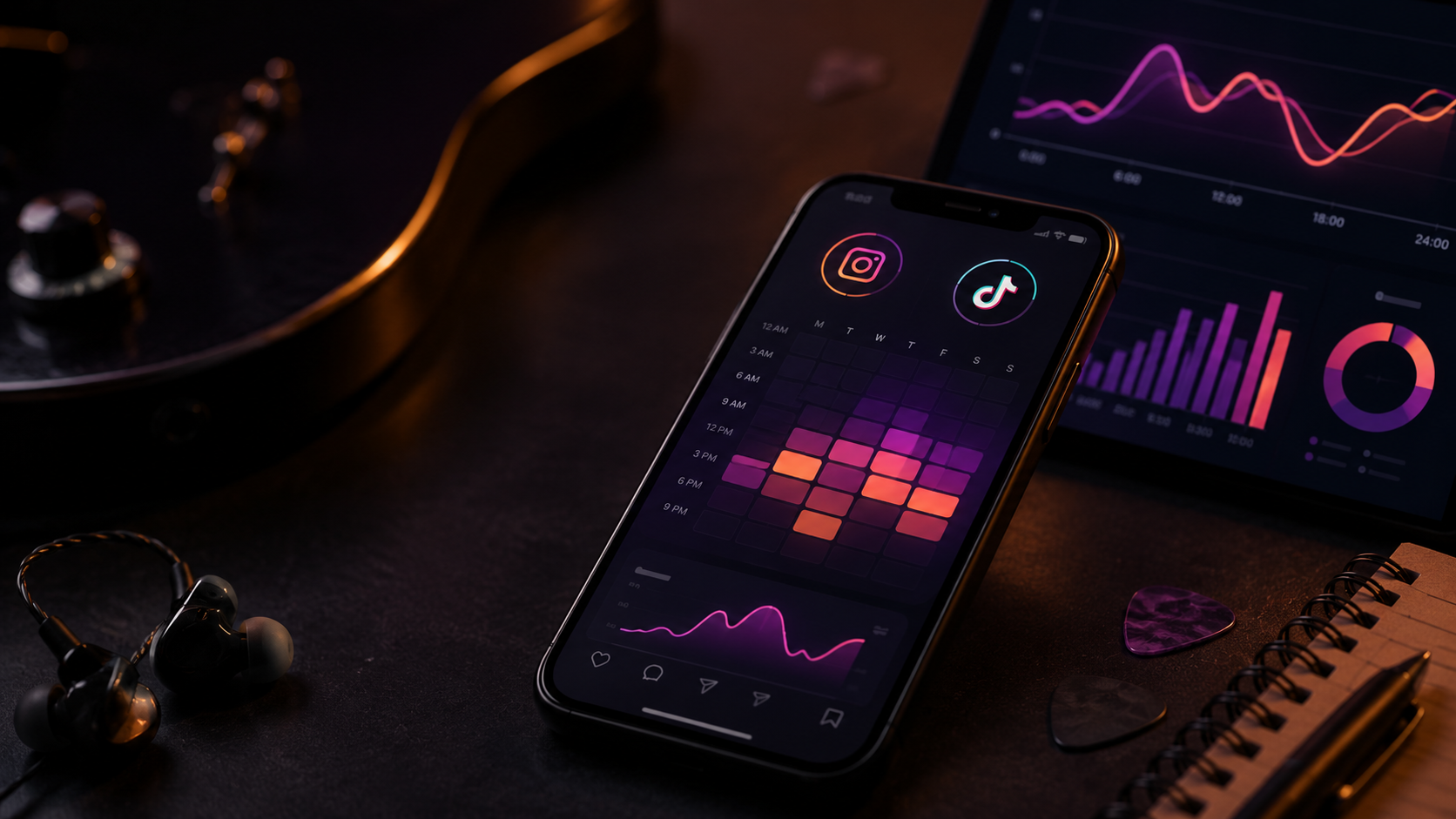
The best time to post for musicians is not a universal hour taken from a generic social media chart. It is the time when your own fans are online, paying attention and ready to watch, comment, share, stream your music or buy a ticket.
What is the best time to post for musicians?
The best time to post is the window in which a meaningful part of your audience is active and able to engage with your content. For one band, that could be during the evening commute. For another, it could be late at night or on a weekend afternoon.
Your ideal posting time depends on where your fans live, how old they are, which platform they use and what type of content you are sharing. A local band with most of its audience in Portugal will probably need a different schedule from a touring artist with followers spread across Europe and North America.
Why generic “best time to post” charts can mislead bands
Search for the best time to post on Instagram or TikTok and you will find dozens of charts recommending different days and hours. One says Tuesday morning. Another says Thursday evening. Another claims weekends perform best.
These charts are usually based on averages collected across thousands of accounts, industries, countries and audience types. Your band is only a very small part of that average.
A generic chart cannot know:
- Where your fans live.
- Which time zones they are in.
- Whether they are students, workers, parents or night owls.
- Whether they use Instagram and TikTok at different times.
- Whether you are posting a live clip, release announcement or ticket link.
- How often your followers normally interact with your band.
Timing also cannot rescue content that gives people no reason to stop scrolling. A strong performance clip published at a reasonable time will usually do more for your band than a weak promotional graphic posted at a supposedly perfect minute.
Think of timing as a multiplier. It can help strong content reach more of the right people, but it does not replace the need for a clear hook, interesting footage and a reason to engage.
Instagram and TikTok may have different peak times
Your followers may behave differently on each platform. Someone might check Instagram during a lunch break, browse Stories throughout the day and open TikTok for a longer session later in the evening.
That means the best time to post on TikTok for bands may not be the same as when to post music on Instagram. Treat each platform as its own audience instead of automatically publishing everything at exactly the same time.
Instagram posting behaviour
Instagram activity is spread across different formats. Feed posts, Reels and Stories can each serve a different purpose.
A Reel may continue reaching viewers long after it is published, while a time-sensitive Story needs to reach fans before it expires or before your event begins. A ticket announcement may also need a different window from a casual behind-the-scenes clip.
TikTok posting behaviour
TikTok can continue distributing a video after its initial publishing window, but the first group of viewers still provides useful engagement signals. Publishing when relevant fans are available to watch a meaningful portion of the video can help you collect stronger early results.
Do not assume that a successful TikTok must be published at the same hour as a successful Instagram Reel. Test the two platforms separately.
How to find your band's real best posting times
You do not need a complicated analytics system. You need enough consistent posts to compare similar content across a few realistic posting windows.
1. Check when your audience is active
Open the analytics or insights section for your Instagram and TikTok accounts. Look for information about follower activity, active days, active hours and audience locations.
Write down two or three promising windows rather than choosing one exact minute. For example:
- Weekday lunch period.
- Early evening after work or school.
- Later evening listening and browsing hours.
- Weekend afternoon.
A window such as 18:00–20:00 is more useful than deciding every post must go live at exactly 18:37.
2. Compare similar types of content
Do not compare a major single announcement with a casual rehearsal photo and assume the difference came from timing. The subject, format and importance of the content were different.
Group your posts into broad categories:
- Performance and live clips.
- Behind-the-scenes content.
- Release announcements.
- Gig announcements and reminders.
- Personal or story-led posts.
- Direct promotional posts with links.
Test similar content at different times. For example, compare several rehearsal clips with one another instead of comparing a rehearsal clip with an artwork reveal.
3. Measure more than likes
Likes are visible, but they are not always the most useful measure for a working band. The right metric depends on what the post was supposed to achieve.
- Watch time: did people stay for the song or scroll away?
- Completion rate: did viewers reach the end of the clip?
- Shares: did fans send the post to someone else?
- Saves: was the content worth returning to?
- Profile visits: did the post create interest in the band?
- Link clicks: did people move towards your music, tickets or EPK?
- Comments: did the post start a genuine conversation?
For a gig announcement, ten ticket-link clicks may be more valuable than hundreds of passive views.
4. Test your posting windows for at least four weeks
One post is not enough to identify a reliable pattern. Performance can change because of the song, opening frame, caption, topic, trend or simple chance.
Test your selected windows for at least four weeks. Publish comparable content consistently and review each post after the same period, such as 24 or 48 hours.
5. Choose a primary and secondary window
Once patterns start to appear, choose a primary posting window and a backup. The backup is useful when your main slot does not suit a particular campaign, time zone or band schedule.
Your final plan might look like this:
- Instagram Reels: weekday early evenings.
- Instagram Stories: spread around announcements and event updates.
- TikTok: later evenings and selected weekend periods.
- Backup window: weekday lunch period.
These are examples of a structure, not universal recommendations. Replace them with the windows supported by your own account analytics.
A simple posting-time test for bands
Use a small testing table to stop your decisions becoming guesswork. You can manage it in a spreadsheet, notes app or your band's shared workspace.
| Post | Platform | Day | Time | Format | Main metric |
|---|---|---|---|---|---|
| Live chorus clip | Tuesday | 18:30 | Reel | Shares and watch time | |
| Live chorus clip | Saturday | 14:00 | Reel | Shares and watch time | |
| Rehearsal hook | TikTok | Wednesday | 20:00 | Short video | Completion rate |
| Rehearsal hook | TikTok | Sunday | 17:00 | Short video | Completion rate |
After several weeks, highlight the combinations that repeatedly perform well. These are your first evidence-based posting windows.
How to schedule posts around release day
Release campaigns need more than one perfectly timed post. Build several moments around the release so fans have multiple opportunities to notice, listen and respond.
Before release day
Use your proven audience windows for artwork reveals, pre-save reminders, song previews and behind-the-scenes clips. Schedule these posts far enough apart that each one has room to reach people.
On release day
Publishing at midnight can make sense when the song becomes available at midnight, but that does not mean your main promotional post must also go live then. Many of your fans may be asleep.
Consider separating your release-day campaign into two moments:
- A simple update when the release officially becomes available.
- Your main video, story or announcement during a proven audience window.
This lets early listeners know the song is live without sacrificing your strongest piece of content to a weak posting hour.
After release day
Continue sharing different angles rather than repeatedly posting the same artwork. Share a lyric moment, live version, fan reaction, production detail or story behind the track.
The best release schedule extends the life of the song instead of treating release day as the end of the campaign.
When to post gig announcements
A gig campaign should be planned backwards from the event date. The goal is not only to create awareness, but to reach people while they can still make plans and buy tickets.
A simple posting sequence could include:
- Initial announcement: publish when the show and ticket details are confirmed.
- Context post: explain why the show matters, who is playing or what fans can expect.
- Reminder: post when people are likely to be planning their week or weekend.
- Final call: publish close to the event while there is still time to act.
- Day-of Stories: share practical updates, soundcheck clips and venue information.
For local shows, prioritize the time zone of the city where the concert is happening. A post designed to sell tickets in Berlin should be scheduled around Berlin, even when a band member is currently travelling somewhere else.
How touring musicians should handle time zones
Touring makes posting times more complicated because your phone's current time, your home audience and the city you are promoting may all be different.
Decide which audience each post needs to reach:
- Local ticket post: use the event city's local time.
- General band update: use the time zone where most followers are based.
- Global release content: choose the strongest overlap between your largest audience regions.
- Live tour content: publish while the moment is fresh, then follow it with a stronger edited post during a proven window.
Always confirm the time zone attached to a scheduled post. This is especially important when crossing borders or when daylight-saving changes occur.
What to do when a post performs badly
A weak result does not automatically mean you chose the wrong time. Review the entire post before changing your schedule.
Ask yourself:
- Was the opening second strong enough to stop the scroll?
- Could viewers quickly understand what the post was about?
- Was the video too long for the idea?
- Did the caption give people a reason to respond?
- Was the content relevant to your existing audience?
- Was the call to action clear and simple?
- Had the account been unusually quiet before publication?
Change one variable at a time. When you alter the time, format, caption, opening frame and video length simultaneously, you cannot tell which change made the difference.
Turn your best posting times into a repeatable workflow
Finding your peak windows is useful only when your band can consistently publish around them. That becomes difficult when posting depends on someone remembering to stop rehearsal, open several apps and upload everything manually.
A practical workflow is:
- Review Instagram and TikTok audience activity.
- Select your strongest posting windows.
- Prepare a week or campaign of content in advance.
- Adapt the caption and format for each platform.
- Schedule the posts in the correct time zone.
- Review performance and update your windows regularly.
Band Social lets you prepare posts, select connected accounts and schedule content from one workspace. Its content calendar gives the whole band a clear view of what is planned, while timezone settings help scheduled times display correctly.
Use Instagram and TikTok's native analytics to identify when your audience is active. Then use Band Social to organize and schedule your content around those windows without relying on someone to remember every post.
Band Social's public-page analytics can also help you review views, link clicks and top referrers, showing which channels are sending people towards your music, shows, contact form or press kit.
Stop searching for one perfect posting time
The best time to post for musicians changes as your audience grows, your location changes and your content develops. There is no permanent universal answer.
Start with two or three sensible windows. Test comparable posts. Measure the actions that matter to your band. Keep the times that perform consistently and review them before each major campaign.
The goal is not to publish at a magical minute. It is to create a reliable system that puts strong music content in front of your fans when they are most likely to pay attention.
Frequently asked questions
What is the best time to post on TikTok for bands?
The best time is when your own TikTok audience is active and likely to watch a meaningful portion of the video. Use your account analytics to identify promising hours, then test similar videos across those windows for several weeks.
When should musicians post on Instagram?
Musicians should post during the periods when their followers are most active, while also considering the type of content. A gig reminder, Story, Reel and release announcement may each need a different schedule.
Should a band post at midnight on release day?
A simple midnight announcement can tell early listeners that the track is available. However, your main promotional video may perform better during the next proven audience window, when more fans are awake and able to engage.
How often should posting times be reviewed?
Review your results regularly and before major campaigns. Audience behaviour can change as your following grows, you enter new markets or a release attracts listeners from different countries.
Does posting at the right time guarantee more reach?
No. Timing can improve the opportunity for early engagement, but the hook, format, relevance and quality of the content remain more important.
Run your band on Band Social
Publishing, scheduling and press kit with Social; venues, outreach and tour money with Booking.
Start free