

The Venue Outreach Email That Gets Replies: Free Booking Template
Use this venue booking email template to contact promoters, introduce your band, share the right proof, and ask for a gig without writing a long or complicated message.
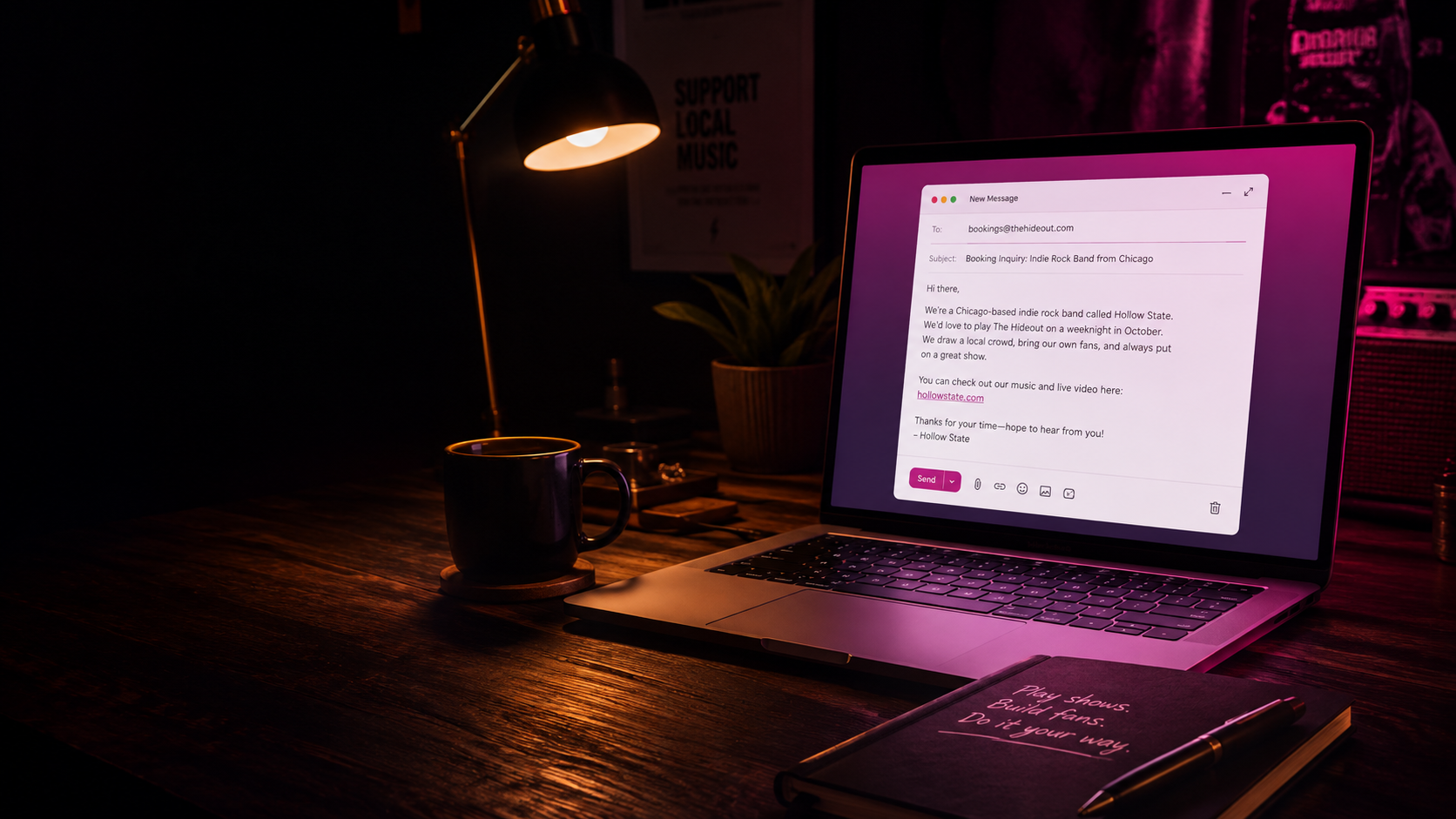
Knowing how to email a venue for a gig can make the difference between getting ignored and starting a useful conversation with a promoter.
A good booking email does not need to be clever or long. It needs to quickly explain who you are, why your band fits the venue, what proof you can provide, and what you are asking for.
In this guide, you will find a complete venue booking email template, subject line examples, a follow-up template, and a simple checklist of what to include before pressing send.
What Makes a Good Venue Booking Email?
Promoters and venue bookers often receive many messages from bands. They usually do not have time to read long biographies or open several large attachments.
Your email should make the important information easy to find.
A strong booking email has four main parts:
- A clear subject line
- A short one-line introduction
- Relevant proof that your band is a good fit
- A direct booking request
If you are still building your full booking process, read our complete guide to booking gigs as an unsigned band.
1. Write a Clear Subject Line
Your subject line should help the promoter understand the email before opening it.
Avoid vague subject lines such as:
- Band inquiry
- Gig request
- Important opportunity
- Check out our band
Instead, include your band name, the city or venue, and the date or period you are looking for.
Venue Booking Email Subject Line Examples
- Booking inquiry — [Band Name] at [Venue Name]
- [Band Name] — available for [City] show in October
- Support slot inquiry — [Band Name]
- [Genre] band looking for a [City] date
- Booking request — [Band Name] on tour, 10–15 October
Keep the subject line simple. Its job is to help the right person understand the request, not to act like an advertisement.
2. Open With a One-Line Pitch
The opening sentence should explain who you are and what kind of band you are.
A useful one-line pitch can include:
- Your band name
- Your genre
- Your location
- A short comparison or description
For example:
We are Black Harbour, a melodic death metal band from Lisbon combining heavy riffs, atmospheric sections, and energetic live shows.
Avoid broad claims such as “we are the next big band” or “we are completely unique.” Describe the band clearly and let your music support the pitch.
3. Explain Why You Are Contacting That Venue
A booking email is stronger when it feels relevant to the venue or promoter.
Show that you have done some basic research. You might mention:
- A similar band that recently played there
- A recurring event that fits your genre
- A specific date you are trying to book
- A city on your tour route
- A suitable support opportunity
For example:
We saw that you regularly book underground metal shows at The Example Room, including the recent Northbound and Hollow Crown date, and we think our band would fit that audience.
This is more convincing than sending the same generic message to every venue.
4. Add Relevant Proof
Promoters need a reason to believe your band can contribute to the show.
Your proof does not need to include huge streaming numbers or sold-out tours. Use what is genuinely relevant to your current level.
Examples include:
- Recent support slots
- Previous shows in the area
- A new single, EP, or album
- A strong live video
- A realistic local draw
- Press coverage or radio support
- Other confirmed dates on the same tour
Be honest. A smaller but accurate claim is more useful than exaggerated numbers.
For example:
We recently supported Example Band in Lisbon, released our new EP in September, and can usually bring around 30 people to a local show.
5. Make a Clear Ask
Do not make the promoter guess what you want.
Ask clearly for:
- A headline date
- A support slot
- A specific date range
- A place on an existing lineup
- Information about future availability
For example:
We are looking for a show in Manchester between 12 and 14 November and would love to be considered for a suitable headline or support slot.
A specific request is easier to answer than “let us know if you have anything available.”
Free Venue Booking Email Template
Copy this venue booking email template and replace the details in brackets.
Subject: Booking inquiry — [Band Name] at [Venue Name]
```Hi [Contact Name],
We are [Band Name], a [genre] band from [city or country]. We are reaching out because [short reason the venue, promoter, or event is a good fit].
We are currently looking for [a headline show, support slot, or date] in [city] around [date or date range].
We recently [mention one or two relevant achievements, releases, shows, or realistic audience numbers]. We think our music would fit well with the audience you are building at [Venue Name].
You can find our material here:
- Music: [link]
- Live video: [link]
- EPK: [link]
Would you have any suitable dates or support opportunities available?
Thanks for your time.
[Your Name]
[Band Name]
[Email Address]
[Phone Number, if relevant]
[Website or social link]
Venue Booking Email Example
Here is the same template completed as a realistic booking email example.
Subject: Booking inquiry — Hollow State at The Hideout
```Hi Alex,
We are Hollow State, an alternative rock band from Birmingham. We are reaching out because we have seen several independent rock and post-punk shows promoted at The Hideout, and we think our sound would fit the venue well.
We are looking for a Manchester date between 18 and 20 October as part of a short weekend run.
We recently released our second EP, supported Northbound in Birmingham, and usually bring between 25 and 40 people to local shows.
You can find our material here:
- Music: hollowstate.com/music
- Live video: hollowstate.com/live
- EPK: hollowstate.com/epk
Would you have any suitable headline or support opportunities during those dates?
Thanks for your time.
Jamie
```
Hollow State
bookings@hollowstate.com
How Long Should a Booking Email Be?
A venue outreach email should usually be short enough to read in less than one minute.
In most cases, aim for:
- Four to six short paragraphs
- One clear request
- Two or three useful links
- No unnecessary band history
If the promoter wants more information, they can open your EPK or ask for it.
What Should You Attach to a Booking Email?
In most cases, it is better to share links than large attachments.
Include These Links
- EPK: Your band bio, photos, releases, contact details, and useful links
- Live video: A clear example of how your band performs
- Music: Your best or most relevant release
Your EPK should be easy to open and view on a phone. Learn what it should contain in our guide to creating an EPK for your band.
What to Leave Out
Avoid sending:
- Large audio files
- Several high-resolution photos
- A long PDF nobody requested
- Every song your band has released
- Multiple live videos
- Unrelated press coverage
Choose your strongest material. Too many links can make it harder for the promoter to know what matters.
What Makes a Good Live Video?
Your live video does not need to be expensive. It needs to show the promoter what your band is like on stage.
A useful live video should have:
- Clear enough sound
- A visible stage and band
- A complete song or strong section
- Real crowd or venue context when possible
- No long introduction before the performance starts
Choose one video that represents your current lineup and sound.
Follow-Up Email Template
If you do not receive a reply, wait around five to seven days before following up.
Keep the follow-up shorter than the original email.
Subject: Re: Booking inquiry — [Band Name] at [Venue Name]
```Hi [Contact Name],
Just following up on the booking email below in case it got buried.
We are still looking for [a show or support slot] in [city] around [date or date range] and would love to be considered if you have anything suitable.
Here are our links again:
- Music: [link]
- Live video: [link]
- EPK: [link]
Thanks again for your time.
[Your Name]
[Band Name]
When Should You Follow Up?
A simple follow-up schedule is:
- Send the original booking email.
- Send the first follow-up after five to seven days.
- Send one final follow-up seven to ten days later.
- Stop if there is still no response.
Do not follow up every day. Promoters are busy, and too many messages can damage your chances of receiving a reply.
Final Follow-Up Template
Subject: Re: Booking inquiry — [Band Name] at [Venue Name]
```Hi [Contact Name],
This is our final follow-up regarding a possible [show or support slot] around [date].
If those dates are not suitable, no problem. We would still be happy to stay in touch for future opportunities.
Thanks again.
[Your Name]
[Band Name]
Common Venue Outreach Mistakes
Sending the Same Generic Email to Everyone
You can use a template, but personalize the venue name, contact, dates, and reason for reaching out.
Writing Too Much
Your full band story belongs in your EPK. The booking email should focus on the opportunity.
Using Exaggerated Claims
Avoid phrases such as “the next biggest band” or “guaranteed to sell out.” Use real information instead.
Sending Too Many Links
Share one music link, one live video, and one EPK. Make the decision easy.
Not Asking for Anything Specific
Include a city, date range, or type of opportunity. A clear request is more likely to receive a clear answer.
Forgetting to Follow Up
A promoter may miss your first email. One or two polite follow-ups can bring the message back to their attention.
Venue Booking Email Checklist
Before sending your email, check that it includes:
- A clear subject line
- The correct contact name
- A one-line description of your band
- A reason for contacting that venue
- A clear date, city, or booking request
- One or two pieces of relevant proof
- A music link
- A live video
- An EPK link
- Your contact information
Check every venue name, date, and link before pressing send. Copy-and-paste mistakes make an otherwise professional email feel careless.
Track Every Booking Email You Send
Sending the email is only one part of the process. You also need to remember who you contacted, when you sent the message, and when the next follow-up is due.
For every venue or promoter, track:
- Venue name
- Contact name
- Email address
- Date of the original email
- Follow-up dates
- Reply status
- Notes from the conversation
- Confirmed dates or next actions
Without a system, it is easy to contact the same promoter twice, forget a follow-up, or lose an important reply.
Send and Track Outreach With Band Social Booking
Band Social Booking helps bands keep venue contacts, reusable email templates, sent messages, and contact history in one workspace.
You can use it to:
- Build a searchable venue and festival list
- Save reusable booking email templates
- Personalize emails with band and venue details
- Send outreach directly from a venue record
- Track delivered and failed emails
- Keep a history of contact, follow-ups, and replies
Explore the full booking workflow on the Band Social features page.
Frequently Asked Questions
What should the subject of a venue booking email be?
Use a clear subject that includes your band name and the opportunity you want. For example: “Booking inquiry — Hollow State at The Hideout” or “Support slot inquiry — Hollow State, October dates.”
Should I attach music files to a booking email?
No. In most cases, send a link to your best release instead. Large attachments can make the email harder to open and may trigger spam filters.
How many times should I follow up with a venue?
One or two follow-ups are usually enough. Send the first after five to seven days and a final message around one week later.
Should I email the venue or the promoter?
Contact the person responsible for choosing the lineup. Some venues book shows directly, while others work with independent promoters.
Do I need an EPK before contacting venues?
You can start outreach without an elaborate press kit, but you should have one simple page containing your bio, music, live footage, photos, and contact details.
Use the Template, Then Make It Personal
A good venue booking email template saves time, but it should never feel completely automated.
Keep the structure consistent while changing the venue, contact name, date, and reason for reaching out. Add honest proof, make one clear request, and give the promoter easy access to your best music, live video, and EPK.
That is the core of how to email a venue for a gig: be relevant, be brief, and make it easy to reply.
Run your band on Band Social
Publishing, scheduling and press kit with Social; venues, outreach and tour money with Booking.
Start free