

How to Write Captions That Sell Tickets (With AI Help)
Learn how to write captions for musicians using a simple hook–context–CTA framework, smarter hashtags, and AI drafts that still sound like your band.
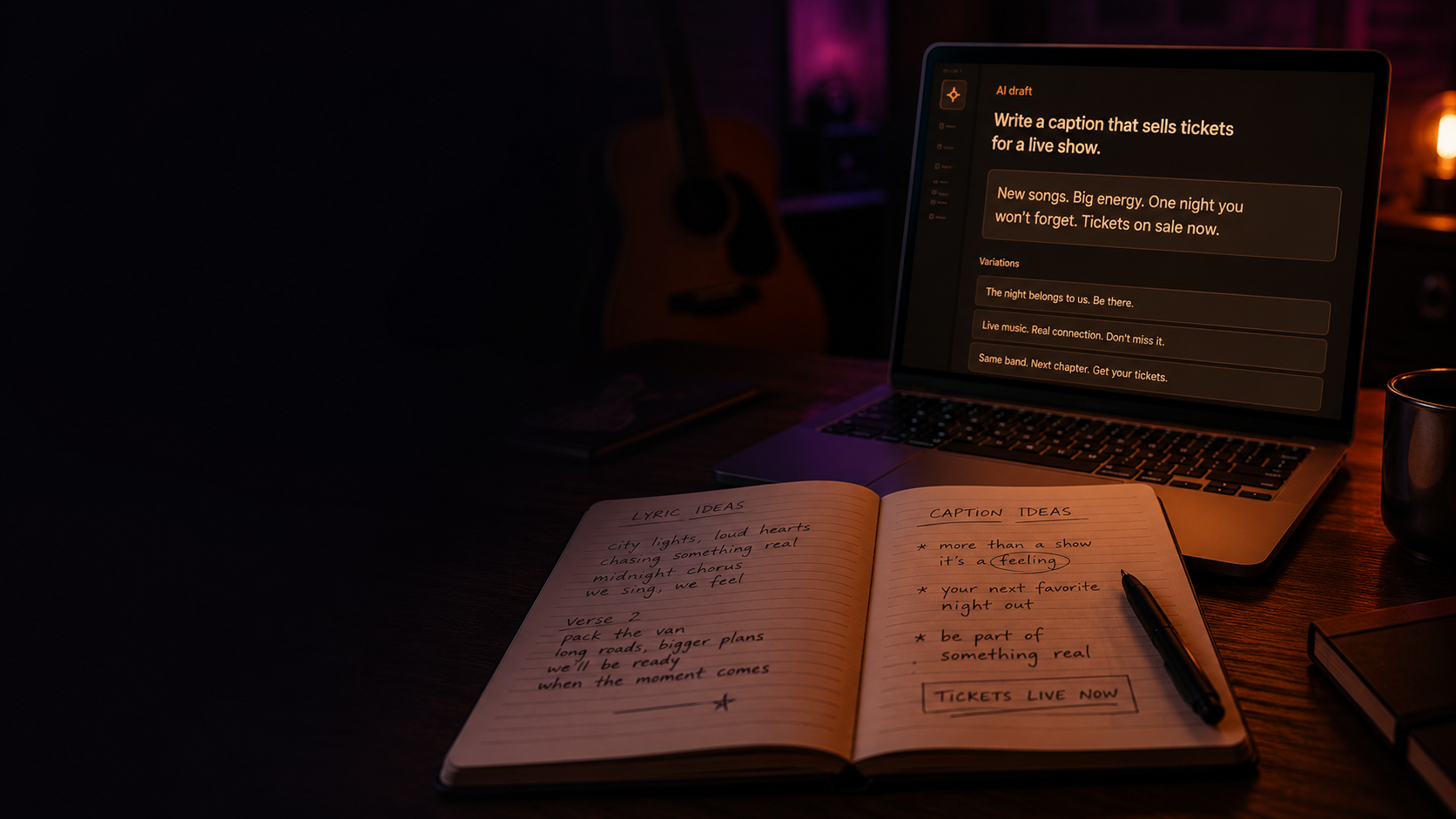
A good band caption should do more than describe a photo. It should give fans a reason to stop scrolling, care about what is happening, and take the next step.
That next step might be listening to a new single, saving a release, sharing a post, or buying a ticket. Whatever the goal, the strongest captions usually follow the same simple structure: hook, context, and call to action.
This guide explains how to write captions for musicians without sounding overly promotional, how to use hashtags more effectively, and how AI can help your band create stronger drafts without losing its personality.
The Simple Caption Structure: Hook, Context, CTA
You do not need to be a copywriter to create effective band Instagram captions. You need a repeatable structure that makes your message clear.
1. Hook
The hook is the first line of your caption. Its job is to make someone pause long enough to read the rest.
Most social platforms shorten longer captions in the feed, which means your opening line needs to work on its own. Avoid starting with background information that only makes sense to the band.
Instead of:
We are excited to announce that we will be playing another show next month.
Try:
London, we are bringing the loudest set we have ever played.
Useful hooks for bands include:
- A direct statement: “Our new single is out now.”
- A question: “Who are we seeing in Manchester?”
- A promise: “This is the first time we are playing the new song live.”
- A moment of tension: “We nearly left this track off the record.”
- A fan-focused line: “You asked us to bring this song back.”
The best hook depends on what the post is trying to achieve. A release announcement should create curiosity or excitement. A gig post should make the night feel specific, immediate, and worth attending.
2. Context
Once the hook earns attention, give people the information they need.
This section should answer the most important questions without turning the caption into a press release:
- What is happening?
- Why does it matter?
- When and where is it happening?
- What makes this release or show different?
Context is also where your band’s personality should appear. Share the story behind the song, something that happened during rehearsals, why you care about the venue, or what fans can expect from the show.
Compare these two examples:
We are playing The Example Venue on Friday. Tickets are available now.
We have spent the last month rebuilding the live set, adding two unreleased songs, and making the ending significantly louder. It all arrives at The Example Venue this Friday.
The second version gives the reader a reason to care. It sells the experience rather than simply listing the event.
3. Call to Action
The call to action, or CTA, tells fans what to do next.
Do not assume people will visit your profile, search for the venue, or find the ticket link themselves. Make the action obvious.
Strong calls to action for musicians include:
- Get your tickets through the link in our bio.
- Save the track and tell us which lyric stayed with you.
- Pre-save the single before Friday.
- Send this to the person you are bringing.
- Comment with the city we should visit next.
Choose one main action. Asking fans to stream, comment, share, save, buy tickets, join a mailing list, and follow another account in the same caption creates friction.
When the goal is ticket sales, the CTA should focus on ticket sales.
Caption Example for Release Day
A release-day caption should quickly explain what has been released, why fans should listen, and where they can find it.
“Running in Circles” is out now.
We wrote this one after a year of making the same mistakes and pretending they were part of the plan. It started as a quiet voice note and ended up becoming one of the biggest tracks on the record.
Listen now through the link in our bio, then tell us which line hits hardest.
The opening line announces the release immediately. The middle gives the song a story. The final line gives fans one clear action and creates a reason to comment.
Caption Example for Gig Night
A gig-night caption should create urgency. Fans need to know that the event is happening soon and that there is still time to attend.
Tonight, Bristol. Last chance to join us.
Doors open at 7:30 PM at The Example Room. We are playing the new single live for the first time, with Northbound opening the night.
A few tickets are still available through the link in our bio. See you at the front.
This version leads with the city and timing, gives the essential event details, adds a reason to attend, and closes with a direct ticket CTA.
Sell the Experience, Not Just the Ticket
Fans rarely buy tickets because a band repeatedly says that tickets are available. They buy because the show feels like an experience they do not want to miss.
Instead of only promoting the transaction, describe what the night will feel like:
- The first live performance of a new song
- A different setlist from the previous tour
- A small venue with limited capacity
- A hometown show
- A strong support lineup
- A final show before a break
- A release celebration
Specific details are more persuasive than generic excitement.
“This is going to be an amazing night” could describe any event. “We are ending the set in the middle of the room with no stage and no backing track” gives fans something they can picture.
How Long Should a Band Caption Be?
There is no perfect caption length for every post. The right length depends on the content and the action you want fans to take.
Use a short caption when:
- The image or video already tells most of the story.
- You are posting an urgent gig reminder.
- You have one simple announcement.
- The CTA is the most important part.
Use a longer caption when:
- You are sharing the story behind a release.
- You want to deepen the connection with existing fans.
- The post needs context to make sense.
- You are sharing a meaningful band update.
Even with longer captions, keep paragraphs short. Large blocks of text are harder to read on a phone.
Hashtags That Still Help Musicians
Hashtags can still help platforms understand the subject of a post, but they should not be treated as a shortcut to reach.
A small group of relevant hashtags is generally more useful than adding a large collection of generic tags.
Use Specific Hashtags
Choose hashtags that describe the artist, genre, location, event, or release.
Examples include:
- #IndieRock
- #ManchesterMusic
- #NewMusicFriday
- #UKBands
- #BristolGigs
- #AlternativeMusic
You can also use a consistent branded hashtag for your band, especially when encouraging fans to share photos or videos from shows.
Avoid Generic Hashtag Piles
Broad hashtags such as #music, #love, #instagood, or #viral are extremely competitive and provide little context about your post.
They can also make a focused gig or release caption look less intentional.
Rather than using every hashtag you can think of, select a few that match the actual post. A local show announcement could combine:
- Your genre
- The city
- The venue or event
- Your band’s own hashtag
For example:
#IndieRock #LeedsGigs #LiveMusicLeeds #YourBandName
Common Caption Mistakes Bands Make
Starting Every Caption the Same Way
“We are excited to announce” is not always wrong, but it becomes invisible when every post begins with it.
Rotate between announcements, questions, stories, observations, lyrics, and direct statements.
Writing Only for Existing Fans
A new follower may not understand internal references, unexplained song titles, or band jokes. Give enough context for someone discovering you for the first time.
Hiding the Important Information
For ticket posts, make the date, city, venue, and ticket action easy to find. Do not bury them beneath several paragraphs of background information.
Using Empty Urgency
Phrases such as “tickets are selling fast” should only be used when they are true. Real urgency is more convincing:
- Only 20 tickets remain.
- Advance sales close at 5 PM.
- This is our only London show this year.
- The early-price ticket ends tonight.
Posting the Same Caption Everywhere
Your core message can stay the same, but the presentation may need to change by platform.
An Instagram caption can support a more visual, story-led post. TikTok copy often works better when it is shorter and closely connected to the opening moment of the video. Facebook may benefit from clearer event details and a direct ticket link.
For a wider strategy covering platforms, posting rhythms, and content types, read the DIY band’s social media playbook.
How to Use AI Captions Without Losing Your Voice
AI captions for musicians work best as drafts, not finished answers.
The goal is not to make every band sound polished in exactly the same way. The goal is to remove the blank-page problem and give you a useful starting point.
AI can help your band:
- Generate several hooks for the same announcement.
- Shorten a long caption.
- Create platform-specific variations.
- Turn basic event details into a structured first draft.
- Suggest clearer calls to action.
- Rewrite a caption in a more direct or conversational style.
However, the first draft will only be as useful as the details you provide.
Give AI Real Information
A weak prompt might be:
Write an Instagram caption for our show.
A stronger prompt would be:
Write an Instagram caption for our indie-rock show at The Example Room in Bristol this Friday. It is our first headline show in the city, we are playing two unreleased songs, and fewer than 30 tickets remain. Keep it energetic and direct. End with a clear ticket CTA.
The second prompt includes the details that make the event worth attending.
Edit the Draft Like a Band Member
Before publishing an AI-generated caption, check:
- Would someone in the band actually say this?
- Does it include any generic or exaggerated language?
- Are the event details correct?
- Is the CTA clear?
- Could one specific detail make it feel more personal?
Replace polished but empty phrases with language your band naturally uses. Add a real rehearsal detail, a lyric, an honest reaction, or a reference your audience will recognise.
Create a Simple Band Voice Guide
AI produces more consistent results when it understands how your band communicates.
A basic voice guide can include:
- Three words that describe your tone
- Words or phrases you often use
- Words you never use
- Whether your captions are usually short or story-led
- How much humour you use
- Whether you speak as “we” or use the band name
- Examples of captions that already sound right
For example:
Direct, warm, and slightly dry. Short sentences. No corporate language. Avoid phrases such as “thrilled to announce” and “musical journey.” Focus on real details from rehearsals, travel, recording, and shows.
Band Social includes a dedicated Band Voice field in the band profile where musicians can record their tone and personality as a reference for how the band communicates. Its social publishing tools also let bands compose posts, add hashtags, choose connected accounts, preview content, save drafts, schedule posts, or publish immediately.
How Band Social Helps You Draft and Publish Captions
Band Social brings caption writing into the same workflow as planning and publishing your content.
Instead of writing captions in one tool, storing ideas in another, and manually copying each post into several platforms, your band can prepare the content in one workspace.
With Band Social, you can:
- Keep your band voice available as a writing reference.
- Draft content for connected social accounts.
- Add and organise hashtags.
- Preview posts while writing.
- Save unfinished ideas as drafts.
- Schedule posts for a future date and time.
- Publish content to multiple supported platforms.
Explore the full social publishing workflow on the Band Social features page.
A Reusable Caption Template for Ticket Sales
Use this template the next time your band announces a show:
[Hook connected to the city, show, or moment]
[One or two sentences explaining what is happening and why the show matters.]
[Date] · [Venue] · [City]
[One clear ticket CTA.]
Example:
Glasgow, we have been waiting for this one.
We are bringing the full new set to The Example Hall on 14 October, including two songs we have never played live before.
14 October · The Example Hall · Glasgow
Tickets are available now through the link in our bio.
Final Caption Checklist
Before publishing, ask:
- Does the first line make someone want to continue?
- Is the most important information easy to find?
- Have we explained why this matters?
- Does the caption sound like our band?
- Is there one clear call to action?
- Are the hashtags relevant to this specific post?
- Have we checked every date, venue, link, and ticket detail?
Write Faster, but Keep It Personal
Learning how to write captions for musicians is less about finding clever phrases and more about making each post clear, specific, and worth acting on.
Start with a hook that earns attention. Add enough context to make the release or show meaningful. Finish with one direct call to action. Use relevant hashtags rather than generic ones, and treat AI as a writing partner that helps you reach a stronger first draft.
Your band’s best captions will not sound like advertising. They will sound like your band giving fans a genuine reason to listen, show up, and be part of what happens next.
Run your band on Band Social
Publishing, scheduling and press kit with Social; venues, outreach and tour money with Booking.
Start free